
Investing 16.7% of annual revenue in R&D, we pioneer the technologies that define the next decade of wireless communication — from 5G-Advanced to AI-native networks and silicon photonics.
Our R&D priorities spanning the next five years of wireless evolution.
Enhanced massive MIMO, AI-assisted beamforming, reduced-capability (RedCap) devices for IoT, and network energy savings features reducing power consumption by 20%+.
Terahertz communications, reconfigurable intelligent surfaces (RIS), joint sensing and communication, and holographic MIMO for sub-millisecond latency and terabit throughput.
Fully autonomous self-healing networks driven by generative AI, digital twin simulation, and zero-touch operations — eliminating manual configuration and reducing OPEX by 50%+.
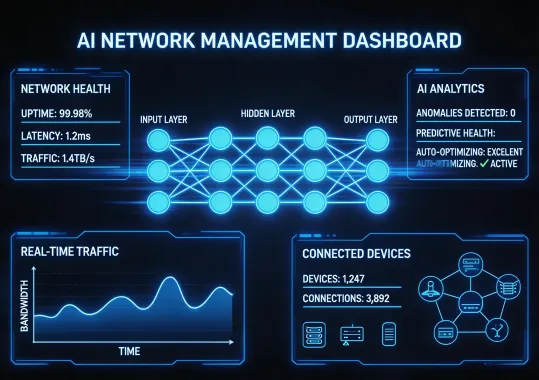
Our proprietary AI/ML engine processes over 2 billion network events daily, enabling predictive fault detection with 97.3% accuracy, autonomous traffic optimization, and real-time anomaly resolution without human intervention.
ZTE actively participates in the O-RAN Alliance, developing open, interoperable RAN solutions that give operators flexibility in vendor selection while maintaining carrier-grade performance. Our O-RAN compliant radio units and centralized units are deployed in 12+ live operator networks.
Discuss O-RAN Integration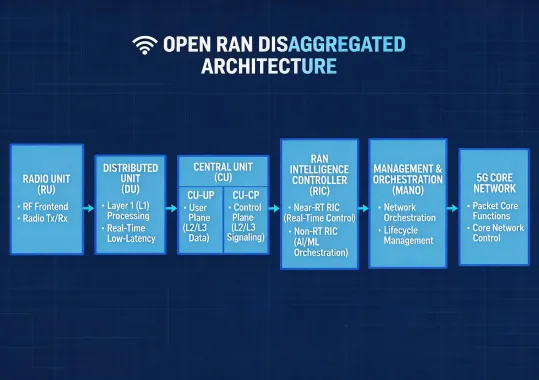
Informed decision-making requires understanding the engineering compromises inherent in wireless network design.
One of the most debated decisions in 5G infrastructure planning is spectrum allocation. mmWave deployments (24-39 GHz) deliver massive bandwidth — up to 800 MHz channel width — and ultra-low latency ideal for dense venue coverage, industrial IoT, and fixed wireless access in line-of-sight scenarios. However, mmWave signals attenuate rapidly over distance and struggle with building penetration, requiring 3-5x more base stations per square kilometer.
Sub-6 GHz deployments (3.5-6 GHz) offer superior propagation characteristics, penetrating walls and covering larger areas with fewer cell sites. This makes sub-6 GHz more cost-effective for nationwide rollout, but peak data rates are 5-10x lower than mmWave. Most operators adopt a layered strategy: sub-6 GHz for broad coverage and mmWave for capacity hotspots. ZTE supports both architectures, and the optimal choice depends on terrain, use case density, and total cost of ownership over a 7-10 year infrastructure lifecycle.
The telecom industry is divided on network architecture philosophy. Single-vendor integrated stacks provide a unified management plane, proven interoperability, and a single point of accountability — reducing deployment risk and accelerating time-to-service. Operators like NTT DOCOMO and China Mobile have historically favored this approach for mission-critical deployments.
Open/disaggregated architectures (O-RAN Alliance specifications) allow operators to mix best-of-breed components from different vendors, avoiding lock-in and potentially reducing hardware costs by 30-40% through white-box switches and commodity hardware. However, multi-vendor integration testing adds 6-12 months to deployment timelines, and performance optimization across heterogeneous equipment remains challenging. ZTE participates in both ecosystems — providing end-to-end integrated solutions and O-RAN compliant components — because the right choice depends on the operator's scale, existing infrastructure, and risk tolerance.
Our intellectual property reflects decades of foundational wireless research.
Universities, research labs, and enterprises — join our open innovation ecosystem to co-create the next generation of wireless technology.
Request an Innovation Briefing About Our R&D